
Securitate file and the rootof Ioan Petru Culianu’s dissent (1971–1974)[2]
- Ioan Petru Culianu’s biography as a refugee and dissident begins not with his departure for Italy (1 July 1972), but with the interception, on 13 July 1971, of a letter sent to him by his mother — copied in triplicate at Office IX of the Securitate in Iași.
- Membership of the P.C.R./U.T.C. did not automatically guarantee him a passport: his first visa application was rejected in July 1971, despite the fact that he had formally been accepted; Culianu had become a party member, according to the testimony of Șerban Anghelescu (2013), through blackmail by the Securitate.
- Culianu’s early dissent (1971–1974), reconstructed on the basis of the A.C.N.S.A.S. files — D.I. 001213 and the two volumes D.P. 13975 —, is structured on five levels: vocational, self-awareness, legal, family-collective and existential.
- The Military Tribunal’s sentence of 29 November 1974 — five years’ imprisonment in absentia, four years’ deprivation of civil rights, and the confiscation of part of the family’s property — attests to the harsh punishment meted out to a man who had not yet published anything explicitly political and whose sole desire was to study the History of Religions.
- The article advocates for an ethic of heightened care when working with the Securitate archives: not for silence regarding the sources, but for a contextualised analysis that identifies the function of each document in the files and avoids the wholesale adoption of intelligence reports of a strictly denunciatory nature.
1. Argument.
The biography of Ioan Petru Culianu—the future historian of religions—as a refugee and dissident begins neither with his departure for Italy (4 July 1972) nor with the official date of registration of the intelligence file (15 June 1973), but with a moment that precedes both: the interception, on 13 July 1971, of a letter from his mother, Elena Bogdan, copied in three typewritten copies at Office IX of the County Security Inspectorate, Iași (here inafter: I.J.S. Iași), under no. 273. Based on the documents in D.I. 001213 and the two volumes of criminal file D.P. 13975 (all at A.C.N.S.A.S.), this article establishes three points.
(i) Culianu’s membership of the P.C.R. and U.T.C. appears in the file as a relevant factor, but not sufficient for the issuance of a passport: every stage of the procedure is contested or subject to conditions within the repressive apparatus, and the rejection of the first application in July 1971 is evidence of this contextual correlation.
(ii) Between July 1971 (the first visa application) and July 1972 (departure, following the second application), an incipient dissent takes shape; it was not yet explicitly political, but rather one that would bring together several characteristics, that of being at once: vocational, defined in its own terms, legal, familial, and existential.
(iii) What follows — the judgment in absentia of the Bucharest Municipal Military Court No. 1020 of 29 November 1974, reduced by Decree-Law No. 212/1974; the material persecution of the family remaining in Iași; the microfilming of the file at Military Unit No. 680 (19 January 1975) — all follow the same consistent trajectory of a self-assumed dissidence, prior to becoming active in journalism (1975–1991, through collaboration with the Social Dialogue Group and/or with publications of the Romanian exile community).
2. Archival sources and a methodological note.
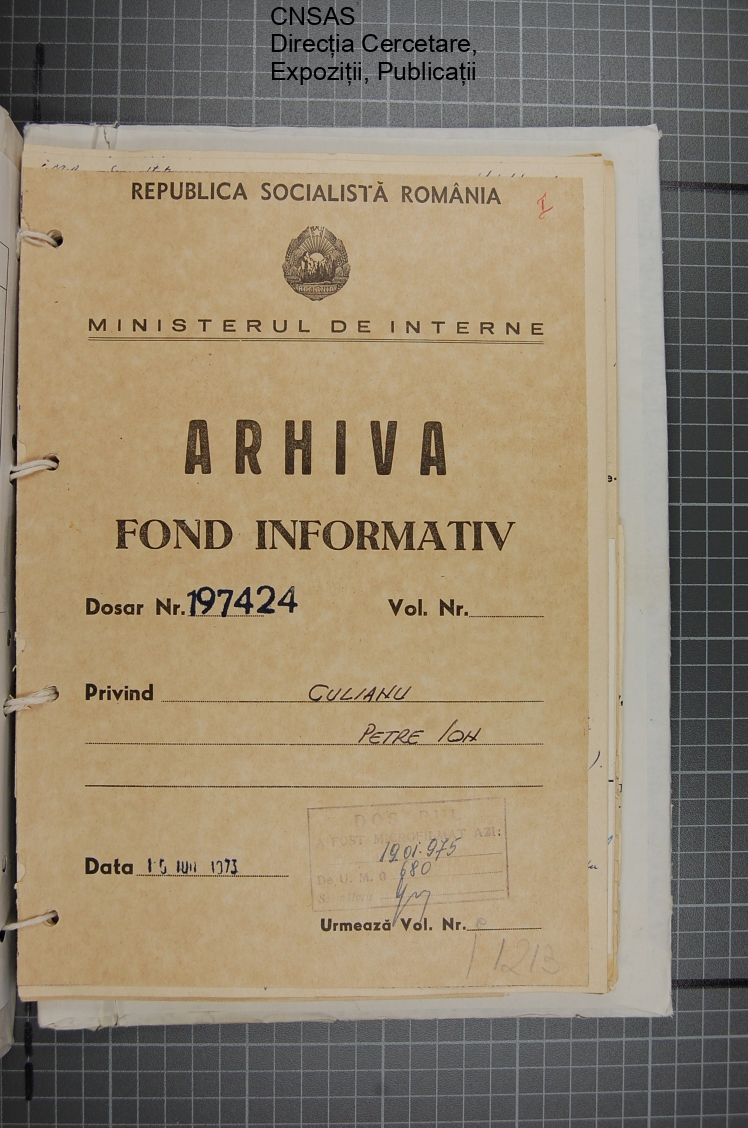
Two Securitate files[3] s relating to Ioan Petru Culianu are held at A.C.N.S.A.S.: the intelligence file D.I. 001213 (69 pages, registered on 15 June 1973 under the Intelligence collection, no. 197424) and the criminal file D.P. 13975, comprising two volumes (vol. I, 9 pages; vol. II, 34 pages). The distinction between the two is important: D.I. 001213 covers the surveillance phase and the preparation of the preliminary investigation, whilst D.P. 13975 documents the actual trial at the Bucharest Military Court. There are also other references[4] — as they are inconclusive for the time being, I will only mention them when necessary.
Before examining the documents themselves, I would like to make a methodological clarification, without which this endeavour would be indistinguishable from journalistic sensationalism. The publication of the documents reproduced below forms part of a research project accredited by A.C.N.S.A.S. and initiated in 2012, with the aim of clarifying the legal and moral status of a specific case , not of simply presenting ‘interesting’ facts.[5] The Securitate files contain an enormous amount of private information — intercepted correspondence, denunciations, descriptions of daily life — which, taken out of context and published without critical analysis, risks perpetuating the very operation of the political police. I therefore advocate an ethic of restraint: not silence regarding sources, but a methodological approach[6] to contextualised citation, identifying the purpose of each document and avoiding the verbatim reproduction of intelligence reports of a strictly denunciatory nature. The documents appended to this article have been selected according to this criterion.
It should also be noted that there is a well-known archival fact: the files relating to Culianu have been partially ‘cleaned up’. The internal pagination of the files indicates gaps, and a comparison with related collections (i.e. the ‘Iași Group’ file) suggests that certain documents were illegally removed or destroyed prior to their handover to A.C.N.S.A.S. This finding limits our research, but sheds light on the Securitate’s activities both within and beyond the country’s borders in Culianu’s case. At the same time, the reconstructable material is sufficient to document the early phase of his dissent (1971–1974).
3. P.C.R./U.T.C. — a necessary but not sufficient element.
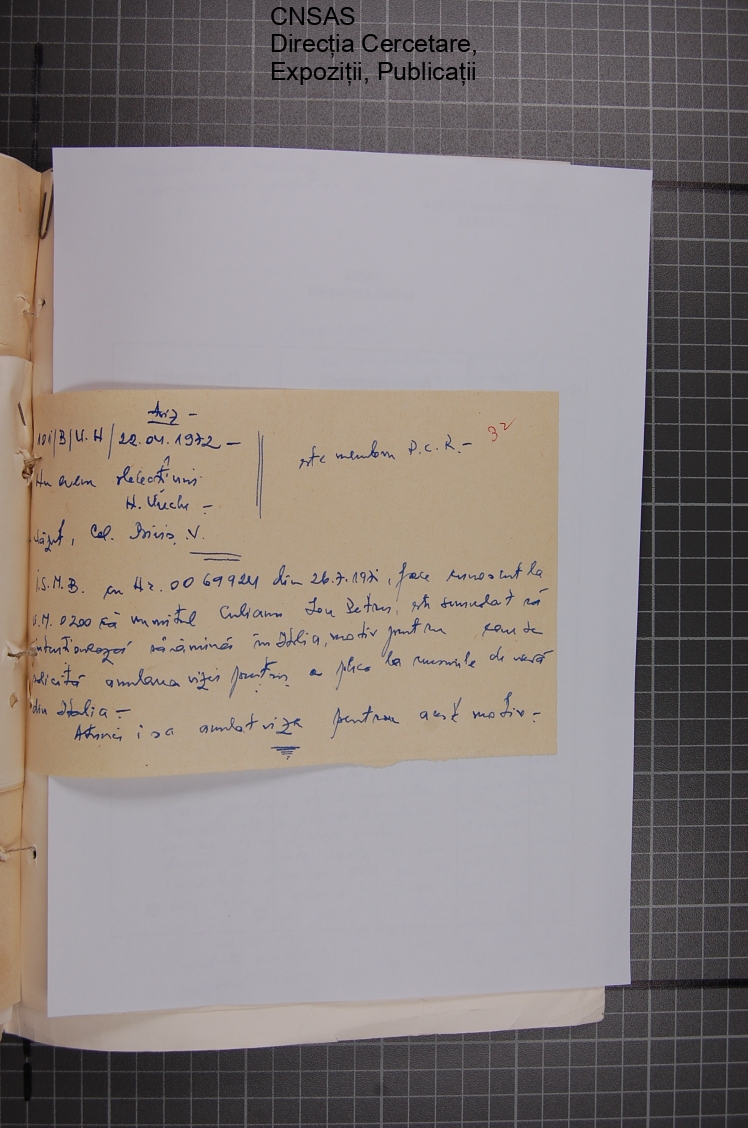
In some post-1989 accounts of Culianu’s biography, the idea circulates, more or less explicitly, that his membership of the P.C.R. ([7] ) and the U.T.C. automatically resulted in the issuance of a passport and a visa for Italy. The D.I. 001213 documents do not confirm this hypothesis. They reveal something more precise and complex: that membership of the PCR is explicitly mentioned as the basis for the favourable opinion regarding the second visa application, that of April 1972 — the document dated 22 April 1972 states that ‘there are no objections’ to his departure, since “Culianu is a member of the Central Committee of the Romanian Communist Party ( P.C.R.)”—but that, at the same time, the first visa application, submitted a year earlier (in the summer of 1971), was rejected on 26 July 1971, immediately after the interception of his mother’s letter.
In other words: the P.C.R./U.T.C. appears in the file as a necessary element for a favourable visa decision, but does not guarantee it. The final decision depends on a cumulative assessment by the Securitate — the interception of correspondence, denunciations, character reports (i.e. “an extremely quiet person, very reserved and diligent in his studies”), references to family, and above all the suspicion — explicitly stated in the February 1973 note from the Passport Directorate — that the person would not return. The rejection of the first application in 1971 is evidence of this contextual dependence: Culianu is, already at the age of 21, a party member whose passport application is refused. The correct thesis is, therefore, twofold: the P.C.R./U.T.C. appears in the file; yet it does not function as an automatic trigger; every stage of the procedure is contested or subject to conditions within the repressive apparatus.
4. Defining an incipient dissidence (1971–1974)
The term ‘dissident’, in the intellectual history of Eastern Europe from the 1960s to the 1980s, has several meanings: the strictly political one (the individual who remains in the country and publicly challenges the regime, even at the risk of physical harm — the Paul Goma model); the broader one (the exile who challenges the regime from abroad, through publications or in the audio and television media, etc.); the cultural one (the scholar who chooses a subject of study structurally incompatible with the official ideology — the so-called ‘resistance through culture’); and the disciplinary one (the author who breaks with the tradition of his own formative school). For the period covered by this article — 1971–1974 — no single definition, taken in isolation, adequately captures the case of Culianu. I therefore propose a composite definition comprising five aspects, each supported by sources.
(i) The vocational meaning. In the context of Romania between 1965 and 1989, the mere fact of daring to believe that the study of the History of Religions automatically entailed refugee status—and of embracing it—demonstrates enormous courage on the part of the young Culianu. The discipline, in direct continuity with the work of Mircea Eliade (officially banned), was ideologically suspect, and mastery of it could only be achieved outside the country. The vocational choice is, in this context, a political decision by virtue of its intrinsic implications, even if Culianu does not intend it to be polemical. Furthermore, in the introduction to the volume Marsilio Ficino (1433–1499) and the Problems of Platonism in the Renaissance (Polirom, 2015), Tereza Culianu mentions at least two elements that I would associate with the status of dissident. Culianu chose the subject of her undergraduate thesis in 1969 under the supervision of Nina Façon, preferring themes from the Renaissance period—thus not exclusively Ficino, but also Giordano Bruno. Culianu, indeed attended several national conferences and received awards. In order to access the bibliography, incunabula and specialist literature, he required a special permit from the secret archives of the Romanian Academy. Also from what Tereza Culianu has said, we know that her brother had been banned from publishing his prose as early as 1970, and that two copies of his thesis were taken out of the country by Prof. Cicerone Poghirc in 1975. Furthermore, immediately after Culianu defended his bachelor’s thesis, Prof. Nina Façon retired, and one of her student’s testimonies attests to the hostile atmosphere and ideological dangers, precisely because she had taken on the supervision of such a subject.[8]
(ii) Self-awareness. In a letter to his mother, Culianu himself articulates his orientation in terms that stand in stark contrast to the official rhetoric:
“… after my PhD, which is due to be completed in four years’ time, following directly in Eliade’s footsteps. […] I seek to fulfil myself as a scholar and writer in complete freedom of thought and creation, as well as in complete freedom of the circulation of ideas.” [9]
At this stage, the triad of thought – creation – circulation of ideas forms the programmatic core of his civil dissent. It anticipates his journalistic stances after 1975 (“Limite”, “Agora”, etc.), but also after 1989, when he would collaborate from exile with the Social Dialogue Group (founded in Bucharest on 31 December 1989) and publish in Revista 22 and Lumea Liberă (New York).
(iii) The conviction. The Bucharest Municipal Military Court convicted Culianu in absentia, by judgment no. 1020 of 29 November 1974, for “the offence of refusing to return to Romania” (Art. 253(1) of the Criminal Code): six years’ imprisonment, reduced to five by Decree-Law No. 212/1974 (published in the Official Gazette No. 146 of 20 November 1974), a legislative act adopted within the broader context of bringing Romanian legislation into line with the International Covenant on Economic, Social and Cultural Rights (ratified by Romania by decree in October 1974, instrument deposited with the UN on 9 December 1974; the Covenant itself entered into force internationally on 3 January 1976). In addition to this: four years’ deprivation of civil rights; reimbursement to the civil party of the sum of 3,244 lei for the unused return ticket from Rome to Bucharest; confiscation, pursuant to Article 68 of the Criminal Code, of half of the family’s property at 25 Sărărie Street, Iași. Decision No. 25 of 14 January 1975 upheld the sentence. On 19 January 1975, D.I. 001213 was microfilmed at Military Unit No. 680. This is the legal aspect of his nascent dissent: a real punishment, measured in years and in confiscated property, imposed on a person who at that time had not yet published anything explicitly political. Subsequently, any attempt by his relatives to obtain his graduation certificate was refused by the Rector’s Office of the University of Bucharest.
(iv) Repression against the family. The cost of dissent is borne by the family members who remain in the country. Elena Bogdan and Tereza-Adela Culianu have been under surveillance since 13 July 1971 (the date the mother’s letter was intercepted), subsequently interrogated on numerous occasions on the basis of Lt-Col Rotaru’s note of 9 April 1974, and the family’s property was partially confiscated by the 1974 court ruling. This mechanism is characteristic of Ceaușescu’s repression against exiles: the dissent of a person living abroad is transferred to the relatives left behind and applied as a visible material punishment. Dissent is therefore, in this case, not merely an individual category, but one that profoundly and enduringly affects the family environment.
(v) The existential level. Tereza Culianu-Petrescu uses, in her account of her brother, the concept of Nekyia[10] to describe his attempted suicide in Latina, in the 1972, shortly before he became a refugee under the 1951 Geneva Convention (subject to the geographical restriction still in force at that time under Italian law, which was only lifted in 1990). His ‘descent into hell’ would lead to a comeback stronger than he himself, yet it reflects the abyss in which thousands of other Eastern European refugees of the era found themselves. The concept is key and reflects all the elements of a personal, individual and family history, namely Culianu’s nascent dissidence, which is both an act of descent and of return, commensurate with the subject matter of his discipline.
The conjunction of these five levels constitutes what I refer to here as Culianu’s dissidence in nuce. The definition is reconstructive (we start from the documents to establish it) and not hagiographic: Culianu is not a dissident because he published a few articles against the regime, but because the biographical trajectory documented in D.I. 001213 and D.P. 13975 cannot be described in any other terms.
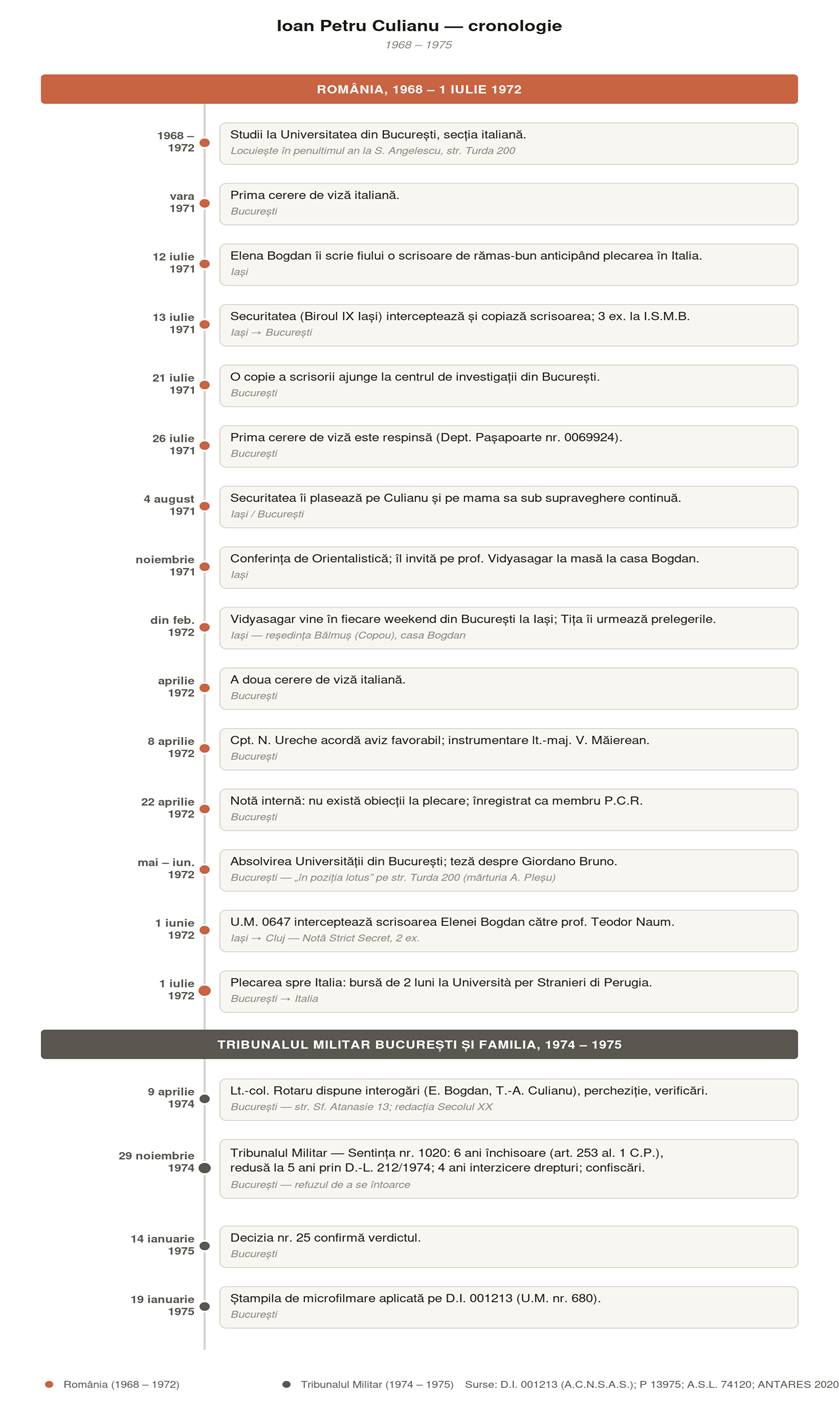
Summary chronology of events (sources: D.I. 001213 / A.C.N.S.A.S.; P 13975).
5. The key letter of 12 July 1971
“… wherever you may be, may my blessings and best wishes be with you [!]” As Elena Bogdan (1907–2000) wrote this letter, with this warm wish, to her beloved son, on 12 July 1971, she could hardly have imagined that Securitate agents might intercept it, let alone that it would provide them with the evidence that enabled them to thwart Culianu’s first attempt to leave Romania. The following day, that is, on 13 July 1971, the letter was intercepted, copied[11] in three typewritten copies, analysed and sent by the head of Bureau IX of the County Security Inspectorate, Iași (hereinafter I.J.S.Iași.), Major Tudor Florian, and by his colleague, Colonel Ionescu Gh. Dumitru[12] , to the counterpart office in Bucharest (hereinafter referred to as I.S.M.B.), one of the three copies reaching the investigation centre on 21 July 1971, namely at I.S.M.B.[13] The correspondence exchanged between these officers contained a marginal note on the document, written by a senior lieutenant, which stated that: “[…] urgent measures must be taken to identify (i.e. by Securitate personnel) that student, to check whether he has already left the country, as well as to check the situation at the Passport Department through him, so that action can be taken before he leaves”. It was merely the beginning of an institutional campaign (by both the Securitate and the Military Tribunal in Bucharest, not to mention the S.I.E. files, which are said to have been destroyed) against one of the brightest students, one of many others who aspired to a better academic education abroad, specifically in the study of the history of religions and Oriental studies.
Returning to the matter of the letter and the circumstances that led Elena Bogdan to write it, I believe it was sent on the same day that Culianu received initial confirmation from the Passport Office regarding his visa application. We know from his sister, Tereza Culianu-Petrescu[14] , that he had already had the opportunity to attend a summer school at an Italian university as early as 1971, that is, a year before graduating, having been recommended by his faculty, as he was considered by his professors to be among the best students. Obviously, he was unable to accept that invitation to the summer school. In 1972, he was again nominated for a scholarship at the University for Foreigners in Perugia, as mentioned earlier. Thus, the interception of the letter, at the very moment when Culianu mistakenly believed he had obtained the visa, took place on 13 July 1971. Within about a week, effective communication between the Securitate services in Iași and those in Bucharest led both to the negative response arriving on 26 July 1971 and to the commencement of surveillance by I.J.S.I. officers of Culianu’s mother (Elena Bogdan) and his sister (Tereza Culianu).
Whilst the young Néné was writing the manuscript for his undergraduate thesis at his home in Bucharest, at 200 Turda Street[15] , in his penultimate year of university, he too could not have imagined that the decision to study abroad would have placed such pressure on his family and on himself. His friend Andrei Pleșu, a little older than him, describes the ‘precarious state of the room: no heating in the middle of winter, a narrow bed, completely covered in books, lacking even the basic amenities of a home. […] Néné looked like someone who never ate… One night, I saw him sitting ‘in the lotus position’ next to the typewriter, finishing his undergraduate thesis: a text dedicated to Giordano Bruno[16] [sic!], written in a torrential style, directly in Italian, in record time.”[17] In fact, even in the information obtained by the Securitate agents, there are reports in which Culianu is described as an extremely quiet person, very reserved and diligent in his studies. Certainly, his strong aspiration for study, as well as his dream of becoming an extremely serious scholar, were not taken into account by the political police, let alone could they impress an ideologised mind. To them, he was merely a subject to be monitored, given that he expressed a desire to go abroad. From 4 August 1971, our protagonist was placed under surveillance by Securitate agents in Iași and Bucharest.
6. The ‘Veronique’ denunciation — factual details
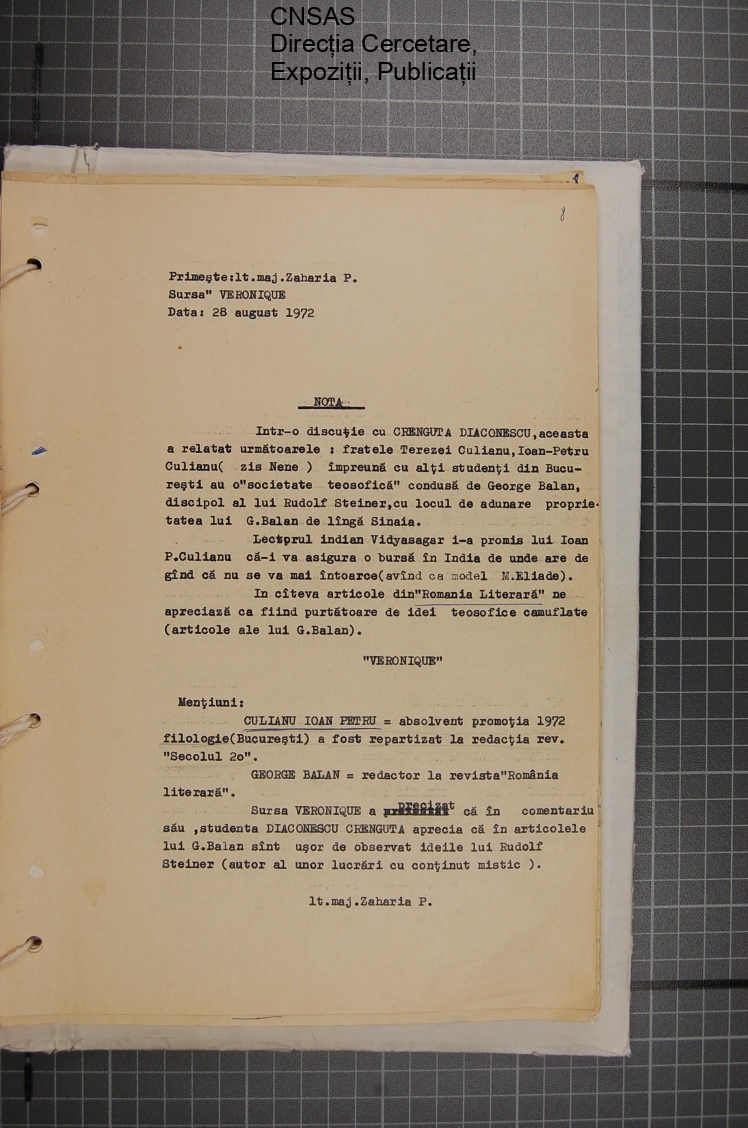
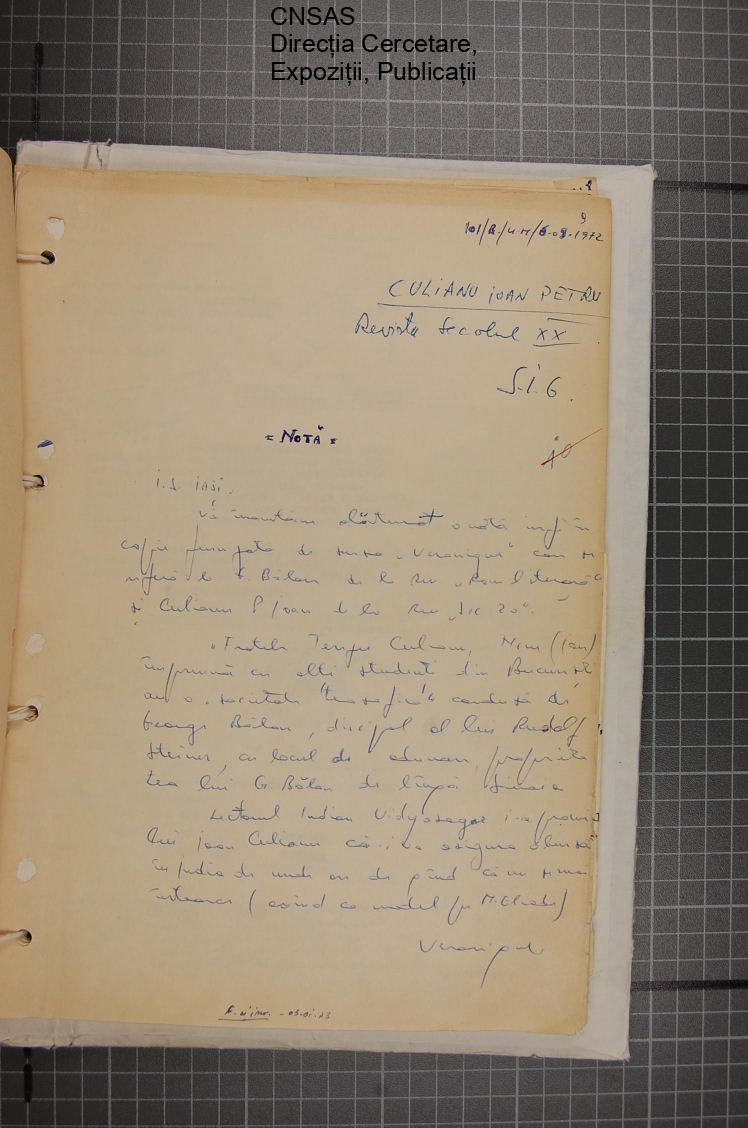
The investigation focuses on family members, work colleagues – Culianu’s last job was as an editor at the magazine *Secolul XX*, whose editor-in-chief at the time was Dan Hăulică –, university colleagues, as well as neighbours, both in Bucharest and Iași. Among the various testimonies from his colleagues, friends and acquaintances – testimonies largely in Culianu’s favour – one denunciation stands out, signed on 29 August 1972 by “Veronique”, a colleague from the Secolul XX editorial office. This report is puzzling in that Culianu’s name is associated with a ‘theosophical society’ coordinated by George Bălan[18] , a disciple of Rudolf Steiner, a society which carries out active work in Sinaia, at Bălan’s private residence. Regarding this report, I would like to make two factual clarifications. First: George Bălan’s circle is directly affiliated with Rudolf Steiner, and is therefore anthroposophical, not theosophical. Anthroposophy separated from the Theosophical Society through Steiner’s action in 1912–1913, precisely along the lines of a doctrinal distinction. The phrase ‘Theosophical Society’ in the ‘Veronique’ note therefore reflects either the source’s confusion or the repressive apparatus’s general imprecision in matters of this kind. I reproduce the term from the document, marking it as such. Secondly: the date of the note — 29 August 1972 — is after Culianu’s departure (1 July 1972). Consequently, the “Veronique” intelligence note cannot be counted among the factors that prevented his departure; functionally, the note forms part of the preparations for the preliminary investigation that would lead to the Military Tribunal’s 1974 verdict. This is an important clarification, because its presentation as an element of the “repressive mechanism” prior to his departure — sometimes erroneously condensed in summaries — does not correspond to the chronology of the case file.
The same document mentions for the first time the name Prof. Dayal Vidyasagar[19] – at that time a professor of Hindi at the University of Bucharest and a close friend of the Culianu family – because the source “Veronique” states that he had promised Culianu a scholarship to study in India, modelled on Mircea Eliade, from where Culianu would never have returned. “Veronique” was a Securitate informant, definitely registered within the network of close collaborators. Her information was immediately appended to the preliminary investigation file against the young historian of religions.[20]
Fortunately, Culianu would submit another application for a visa and passport in April 1972. According to a report by a Securitate agent, Lieutenant-Major Măierean Vasile, we know that he obtained a favourable recommendation (from Captain N. Ureche) on 8 April 1972. Most likely, the date of his departure for Italy was 1 July 1972, not 4 July 1972, if I take into account the sources mentioned above. I have not found any documentation among the papers relating to the processing of the second visa application for Italy, but the dates I specified earlier appear in the files of the preliminary investigation and the Military Tribunal’s conviction. Finally, a document[21] dated 22 April 1972 states that there were no objections to his departure, that Culianu is a member of the P.C.R., and that I.S.M.B. agents reiterate that the first visa was not granted because he was suspected of not returning to Romania.
7. The judgment in absentia and the costs borne by the family
[22]Indeed, the Bucharest Military Court would convict Culianu, in absentia, for the “offence of refusing to return to Romania” (Article 253(1) of the Criminal Code): six years’ imprisonment, reduced to five years under Decree-Law No. 212/1974, following Romania’s ratification of the International Covenant on Economic, Social and Cultural Rights (in force since 20 November 1974). Four years’ deprivation of civil rights; reimbursement to the civil party of the sum of 3,244 lei for the unused return ticket Rome–Bucharest; confiscation, pursuant to Article 68 of the Criminal Code, of half of the family’s property at 25 Sărărie Street, Iași. Elena Bogdan and Tereza-Adela Culianu were repeatedly interrogated on the basis of Lt-Col Rotaru’s note of 9 April 1974. Decision No. 25 of 14 January 1975 confirmed the sentence. On 19 January 1975, intelligence file D.I. 001213 was microfilmed at Military Unit No. 680.
Being a refugee and aspiring to study for a degree at a European university during the Iron Curtain era was a desperate situation. In fact, Culianu’s sister makes inspired use of Nekyia’s concept when she mentions[23] in brief her brother’s suicide attempt whilst he was in Latina, shortly before becoming a ‘refugee within the meaning of the 1951 Geneva Convention’[24] This “descent into hell” would give Néné a comeback stronger than himself, yet reflecting the abyss in which thousands of others like him find themselves.
In the next article in this series (publishing documents relevant to his biography) dedicated to Ioan Petru Culianu – refugee and dissident, I shall publish sources that trace his profile as a political refugee with great precision, based on unpublished documents from the Centro di Emigrazione di Latina, AAI/CIME Latina, personal file no. 74120 (State Archives of Latina), opened in Trieste on 13 November 1972 and closed in Latina on 13 September 1973; correspondence from the Sacro Cuore Catholic University dated October 1973 (Lazzati, Cantalamessa), letter intercepted in D.I. 001213, ff. 28r–v.
Appendix
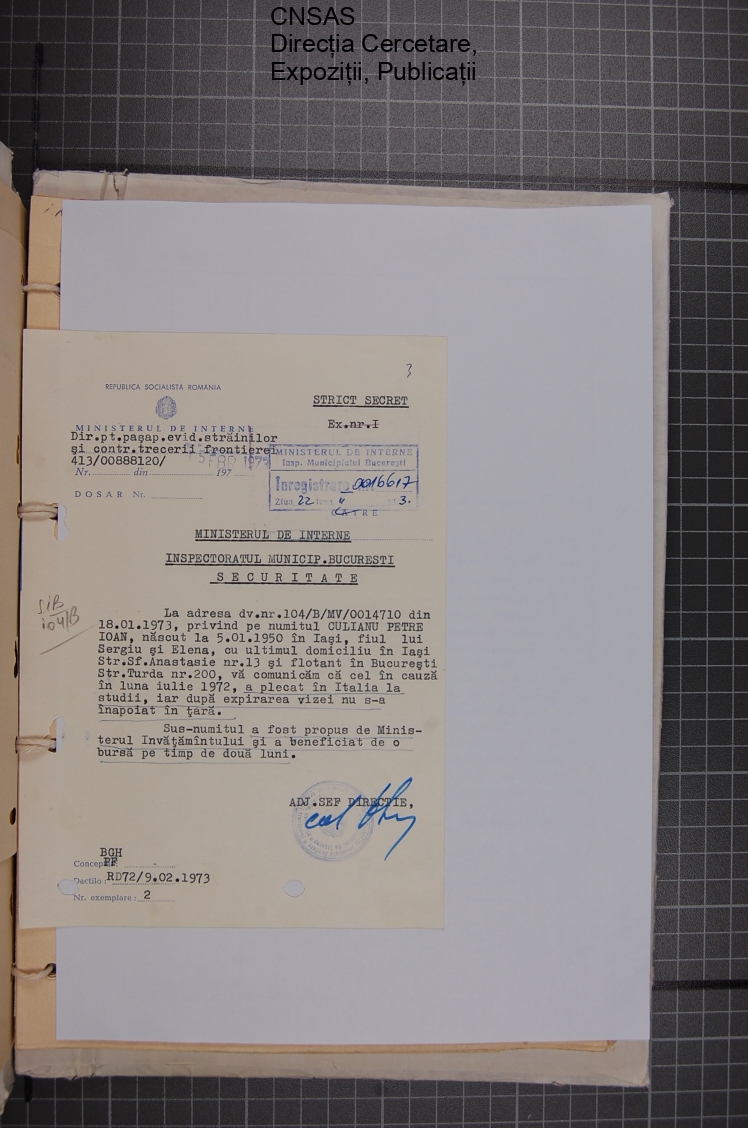
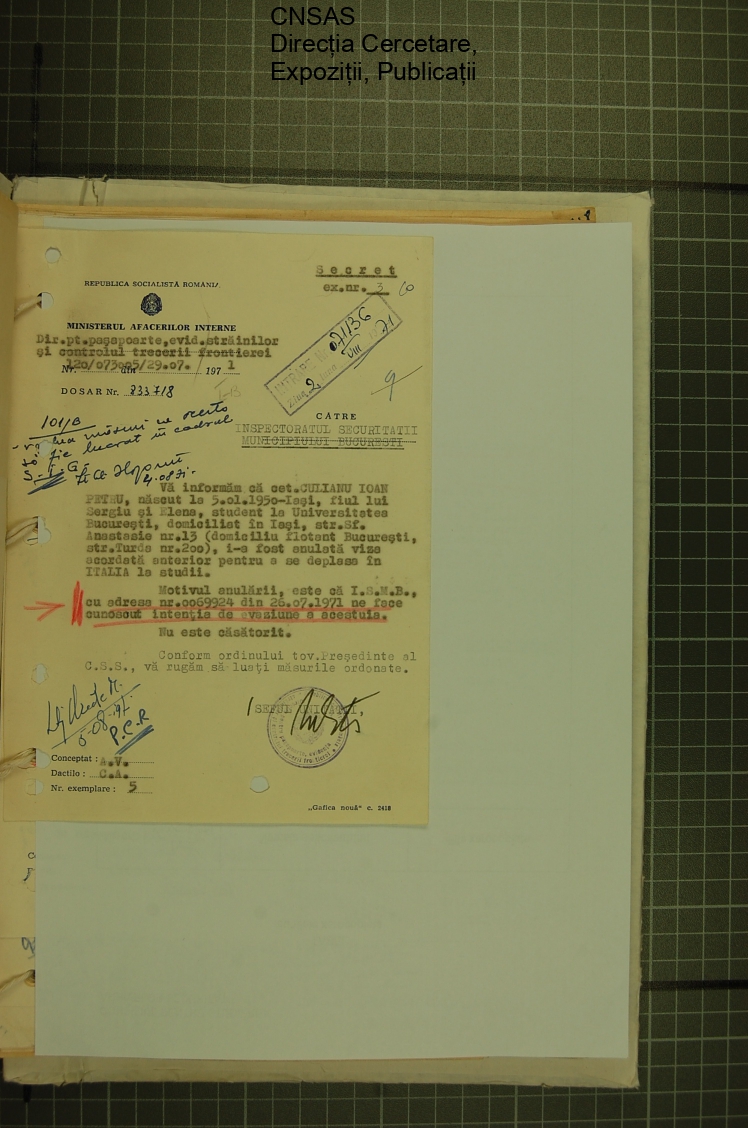
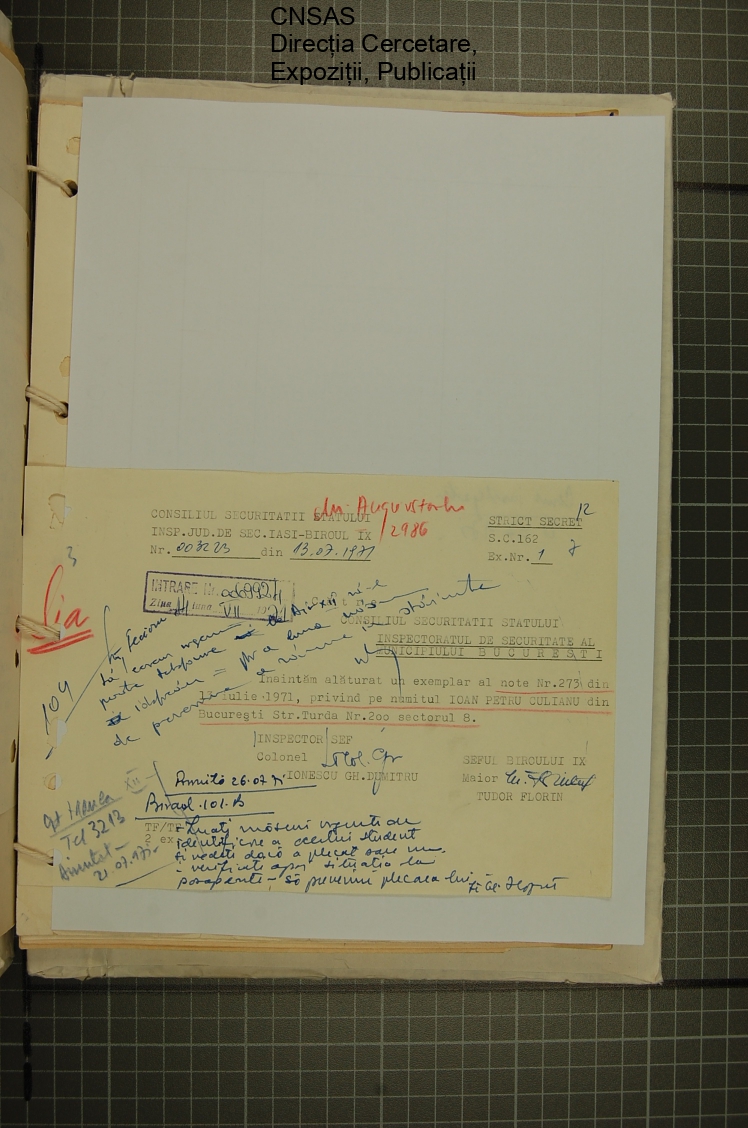
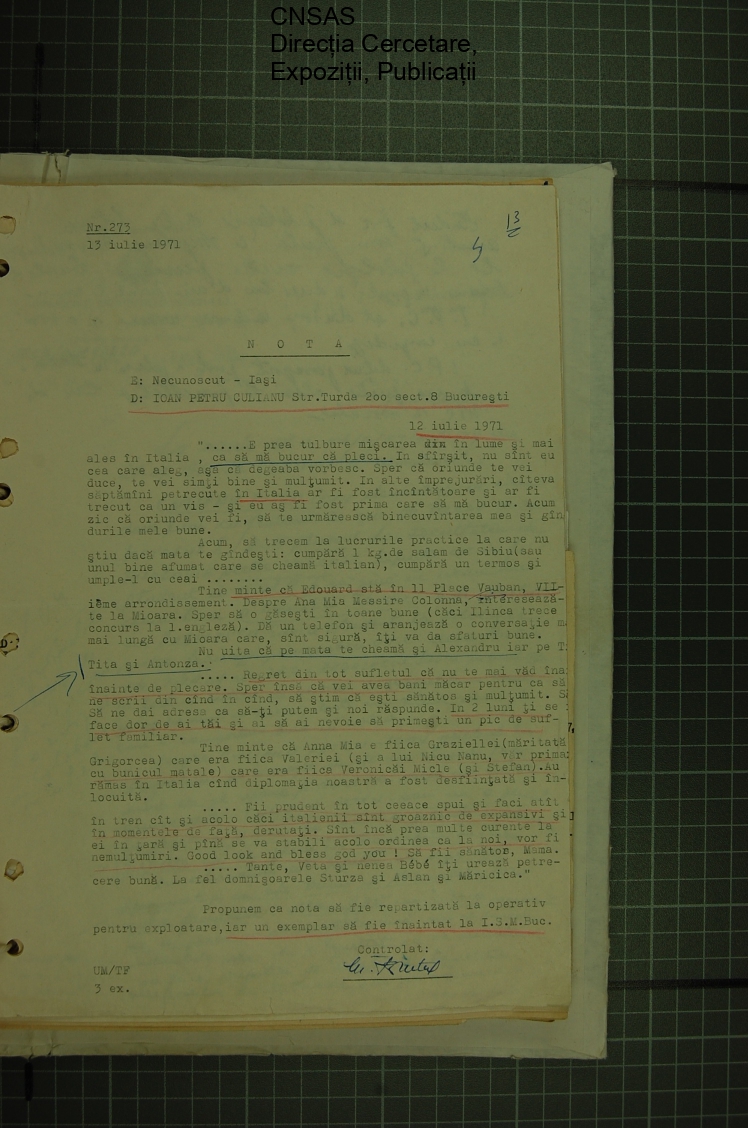
Excerpts from Elena Bogdan’s letter to Ioan Petru Culianu, 12 July 1971 [copy made in Office IX of the State Security Council, Ministry of the Interior – Iași Regional Inspectorate, on 13 July 1971, registered under no. 273] © A.C.N.S.A.S., Fond Informativ, D.I. 001213. Reproducere autorizată în temeiul acreditării de cercetare; republicarea de către terți este interzisă.
13 July 1971
NOTE
E: Unknown – Iași
D: IOAN PETRU CULIANU 200 Turda Street, Sector 8, Bucharest
12 July 1971
“… Things are too unsettled in the world, and especially in Italy, for me to be glad you’re leaving. After all, it’s not up to me, so there’s no point in me saying anything. I hope that wherever you go, you’ll be happy and content. Under different circumstances, a few weeks spent in Italy would have been delightful and would have passed like a dream – and I would have been the first to rejoice. Now I say that wherever you may be, may my blessing and my good thoughts follow you.
Now, let’s move on to the practical matters I’m not sure you’ve thought of: buy 1 kg of Sibiu salami (or a well-smoked one, known as Italian), buy a flask and fill it with tea […][26]
Bear in mind that Edouard lives at 11 Place Vauban,7tharrondissement. As for Ana Mia Messire Colonna, ask Mioara about her. I hope you find her in a good mood (as Ilinca is sitting her English exam). Give her a ring and arrange a longer chat with Mioara, who, I’m sure, will give you some good advice.
Don’t forget that Alexandru, [T.]Tita and Antonza are all calling for you.
[…] I deeply regret that I won’t see you before you leave. I do hope, however, that you’ll have enough money at least to write to us from time to time, so we know you’re healthy and happy. Do give us your address so we can write back to you. In two months’ time you’ll miss your family and you’ll need a bit of a familiar touch.
Remember that Anna Mia is the daughter of Graziela (married name Grigorcea), who was the daughter of Valeria (and of Nicu Nanu, your grandfather’s first cousin), who was the daughter of Veronica Micle[27] (and of Stefan)[28] . They remained in Italy when our diplomatic mission was disbanded and replaced.
[…] Be careful in everything you say and do, both on the train and once you’re there, for the Italians are terribly outspoken and, at the moment, confused. There are still too many factions in their country and until order is established there as it is here, there will be discontent. Good luck and God bless you! [sic!] Stay well, Mum.
[…] Auntie, Veta and Uncle Bébé wish you a happy party. So do Misses Sturza and Aslan, and Măricica”
We propose that the note be forwarded to the operations department for processing, and that a copy be sent to I.S. M. Bucharest.
UM/TF
3 copies Verified
Illegible signatures
[1] Ioan Petru Culianu, Intelligence File I 001213 (hereinafter referred to as D.I. 001213), source: Archive of the National Council for the Study of the Securitate Archives – collection of unpublished documents; registered with the Foreign Intelligence Service (hereinafter referred to as S.I.E.), under number 197424.
[2] This text, with quite a few differences, was originally published in the special issue of the journal Antarès no. 18: D. Dumbravă, ‘Il passaporto per l’Italia di Culianu. Raccolta di documenti inediti’, Ioan Petru Culianu. Argonauta della Quarta Dimensione, edited by Horia Corneliu Cicortaş, Roberta Moretti and Andrea Scarabelli, Editrice Bietti, Milan, 2021, pp. 69–75.
[3] It is possible that, over the years, other files referring to Ioan Petru Culianu’s intelligence files may have emerged, or that the Foreign Intelligence Services may even have handed over another batch of files from the D.I.E. archive containing new files on him, particularly from his time as a professor at the University of Groningen and in the United States. There is also the hypothesis that his files in the S.I.E. archive, dating from after 1974, may have been destroyed. In my opinion, if this hypothesis regarding the destruction of the S.I.E. files relating to the ‘fugitive’ Culianu, by the Secret Services which were active particularly in the years 1989–1991, provides a solid basis for a possible investigation and analysis of Culianu’s assassination in Chicago on 21 May 1991. A careful examination of the indexes and the simultaneous cataloguing of the documents contained in the files relating to his name, often found on S.I.E. microfilms – within the Security Archives and their archiving system, part of which is also held at A.C.N.S.A.S., as well as of all files linked to him, particularly those concerning informants active abroad – could prove a rewarding endeavour for the researcher seeking to untangle the Gordian knot surrounding the crime that took place in the toilet of the Divinity School in Chicago.
[4] The intelligence file, on which I shall dwell at greater length, contains documents relating to the preparations for Culianu’s departure to Italy: (i) the visa application; (ii) his letters to his family, all intercepted by the Securitate; (iii) correspondence between various institutions under the Securitate’s control; (iv) various denunciations which would also form the basis for the opening of a preliminary investigation file against him, an investigation initiated by the Military Tribunal in Bucharest; (v) as well as some of the documents issued by the Catholic University of Milan, namely the entire documentation he submitted to the Romanian authorities, after winning a scholarship to study at the Catholic University of Milan, with a view to obtaining his degree and academic record from the University of Bucharest.
[5] There is a long series of publications from the last fifteen years, accepted by Romanian publishers without reservation, very often lacking any real review or supervision by a scientific committee, as well as a suitable person to coordinate a collection specialising in A.C.N.S.A.S. studies. This is an entirely different discussion, namely the issue of establishing groups for methodological reflection and historiographical approaches to the study of documents in this type of archive, apart from the A.C.N.S.A.S. research team, which is nevertheless attempting to establish a platform for debate, the provision of information, the digitisation of files and reference documents, collections of studies, etc.
[6] See Gabriel Andreescu’s pertinent analysis in Scholars, Opponents and Documents. Manipulations of the Securitate Archives, Polirom Publishing House, Iași, 2014, which demonstrates, through various case studies focusing exclusively on Romanian intellectuals—both those in exile and those imprisoned in Securitate jails for political reasons—that, in the absence of an appropriate methodology for studying A.C.N.S.A.S. documents and a lustration law, the temptation to publish this type of document far outweighs the virtue of refraining from doing so without damaging their public image and without becoming sources of manipulation of collective memory, with serious consequences for individual freedom, particularly for living persons and/or their families. The well-known cases of the writer Adrian Marino and the historian and human rights activist Mihnea Berindei constitute evidence of this, according to Andreescu’s analysis. See also my article “History is about understanding (Verstehen)” in https://www.contributors.ro/istoria-este-despre-a-ințelege-verstehen/, contributors.ro, published on 6 November 2019 and accessed on 15 May 2026.
[7] In 2013, I had the opportunity to meet his colleague and friend in Bucharest, Șerban Anghelescu, now a well-known ethnologist, who told me about the blackmail and pressure exerted on Culianu to join the Romanian Communist Party (P.C.R.): Culianu became a member of the party immediately after graduating from university, as a result of blackmail by the Securitate, having been accused of meeting with a group of Italian anarchists and, consequently, of committing a criminal offence. Mr Șerban Anghelescu also mentions the name of Victor Ivanovici, another of their colleagues who could corroborate his testimony.
[8] For further details on these biographical aspects, see Tereza Culianu’s ‘Note on the Edition’ in the volume Ioan Petru Culianu, Marsilio Ficino (1433–1499) and Problems of Platonism in the Renaissance, edited by Tereza Culianu, Polirom Publishing House, Iași, 2015, pp. 5–8.
[9] Letter intercepted by the Securitate, included in D.I. 001213 which we will publish in the next article on contributors.ro.
[10] Nekyia, nèkyia n., Gr. [transliterated from νέκυια, derived from νέκυς, an archaic form of νεκρός ‘dead’]. Among the ancient Greeks, a sacrifice or ritual through which the dead were summoned for divinatory purposes. The word is traditionally used to refer to Book XI of Homer’s Odyssey, which recounts the episode of Ulysses summoning the seer Tiresias before descending into the realm of the dead. The term used by Tereza Culianu refers to the concept of nekyia, which can take place anywhere (primarily in the afterlife, but not exclusively), provided that the spirits of the afterlife are invoked and a dialogue is conducted with them. It appears to be a profound ritual interaction with the divine or spiritual realm. There has been much speculation that Culianu himself assumed the role of a necromancer, but that is another matter. Undoubtedly, Tereza Culianu is not referring to this aspect here.
[11] Sheet 13 f/v [Doc. 2 in the Annex], from D.I. 001213, with the original registration number 273/13 July 1971, a document attached to sheet 12 of the same intelligence file.
[12] In the digital copy requested by AC.N.S.A.S., the names of the officers, like many others, were not redacted, which is why they are reproduced here.
[13] Sheet 12 f/v [Doc. 3 in the Annex], from D.I. 001213, with the original registration number 003223/13 July 1971.
[14] Tereza Petrescu Culianu, “A Biography”, in Ioan Petru Culianu. The Man and His Work, edited by Sorin Antohi, Polirom Publishing House 2003, p. 63, a slightly modified reprint of the text published in Observator cultural, no. 87, 23–29 October 2001.
[15] Culianu was staying with his friend and colleague Silviu Angelescu (1945–), at 200 Turda Street, Bucharest. In a letter dated 27 May 1977, addressed to Andrei Pleșu, Culianu confesses that: “The period on Turda Street was perhaps the richest of my life”, in Observator Cultural, no. 87, 23–29 October 2001, p. 12, text reprinted in Ioan Petru Culianu, Arta Fugii, edited by Dan C. Mihăilescu, Polirom Publishing House, Iași, 2011, p. 11, n. 2.
[16] This is a case of confusion on Andrei Pleșu’s part, but we know from Tereza Culianu’s account that Néné had also worked intensively on themes relating to the work of Giordano Bruno.
[17] Andrei Pleșu, ‘A Friendship and a Few Missed Encounters’ in Observator Cultural, no. 87, 23–29 October 2001, p. 12, text reprinted in Ioan Petru Culianu, The Art of the Fugue, edited by Dan C. Mihăilescu, Polirom Publishing House, Iași, 2011, pp. 11–12.
[18] An aesthetic philosopher who taught at the Conservatoire (now the National University of Music, Bucharest).
[19] Prof. Prabhu Vidyasagar Dayal, a close associate of the Sanskrit scholar Sergiu Al-George, a lecturer in Hindi at the University of Bucharest between 1968 and 1972 and 1975 and 1978, having come from Osmania University in Hyderabad, was also invited for a short period to the University of Iași between 1971 and 1972. Among other works, he is the author of the Hindi-Romanian Dictionary, vols. I–IV, in collaboration with I. Petrescu, Faculty of Romance, Classical and Oriental Languages, Department of Hindi Language and Literature, Bucharest, 1973–1976.
[20] Pages 8 (f) – 9 (f) of D.I. 001213.
[21] Page 32 (f) of D.P. 13975, vol. 2, attached as document no. 5 in the annex.
[22] Judgment No. 1020 of 29 November 1974 [and the final judgment, by Decision No. 25 of 14 January 1975] of the Military Court of Bucharest, in criminal case: P 013975 [P = criminal; classified by A.C.N.S.A.S.], Vol. 1, sheet 2 f/v. [Furthermore, as previously noted, Culianu’s files are also classified and registered at other branches of the former Securitate archives; in this case, P 013975 also appears as a file microfilmed on 31 July 1976 and previously filed under number 848/1974 or 5968, or P13975/1]. This ruling was the subject of a debate entitled: How do we read the A.C.N.S.A.S. documents? Do historians need case law? [Case study: the conviction of Ioan Petru Culianu], held on 17 December 2013, in the Stoicescu Hall – Faculty of Law, University of Bucharest. The debate was attended by Daniela Dumbravă – researcher at the Institute of the History of Religions – Romanian Academy (initiator and organiser together with ELSA, The European Law Students’ Association, Bucharest), Dragoș Petrescu – President of the C.N.S.A.S., Silviu Moldovan – researcher at the C.N.S.A.S., and Cristi Dănileț – magistrate and, at the time, member of the Superior Council of Magistracy. In addition to aspects that lent themselves to a new methodological approach for historians, magistrate Dănileț analysed Culianu’s criminal trial, considering it an abuse and a miscarriage of justice, given that Romania, from 1972 onwards, had signed, amongst other treaties, the treaty on the free movement of its citizens, with a view to obtaining Most Favoured Nation (MFN) status from the United States of America.
[23] Tereza Culianu, ‘A Biography’, in Ioan Petru Culianu. The Man and His Work, edited by Sorin Antohi, Polirom Publishing House 2003, p. 64.
[24] Ibid.
[25] We find this letter as document no. 273, dated 13 July 1971, copied in three copies from the handwritten version as a typewritten document, in D. I. 001213, source: A.C.N.S.A.S.; the text was underlined by Securitate agents.
[26] The text is missing from the letter copied by the Securitate agents.
[27] Veronica Micle (1850–1889), poet and lover of Mihai Eminescu, wife of Ștefan Micle from 1864.
[28] Ștefan Micle (1820–1879) married Veronica (née Câmpeanu) on 7 August 1864; at the time, he was a professor of physics and chemistry at the Faculty of Physics and Chemistry of the University of Iași, and from 1860 rector of the same university, between 1867 and 1875.